New!Clean Pure Christlike energy to move 1063 pounds of bricks in one sheer movement using the power of a man's back or horses requires energy.That is all!Abraham had no four wheel engined vehicle but he had faith and common sense to do whatever God demanded of him in a way that was efficient and respectful to all of God's creation of which he was a part.Abraham also had no written law; also true for Joseph or Jacob or Moses when Moses crossed the red sea.All posts are authored by Warren A.Lyon.
Barack Obama's original sin: America's post-racial illusion
Barack Obama’s refusal to use his position as president to intervene
on behalf of African Americans is a stain on his record many activists
will never forget
by Keeanga-Ya Ya Taylor
666 Shares
In
the first hours of the new year in 2009, just weeks before Barack Obama
was to be inaugurated as the next president, shots rang out in Oakland,
California. A transit officer named Johannes Mehserle shot an unarmed
22-year-old black man who lay face-down in handcuffs on a public
transportation platform. His name was Oscar Grant.
Dozens of witnesses, many of whom were returning to Oakland after New Year’s Eve celebrations, watched in horror. Some captured
his killing on smartphones. Shortly afterward, black Oakland exploded
in palpable anger, with hundreds, then thousands of people taking to the
streets, demanding justice.
Perhaps this outcry would have happened under any circumstance, but
the brutality of Grant’s death in the few weeks before the country’s
first black president was to take office felt like a shock of cold
water. Police brutality had long been a fact of life in California, but
the country was supposed to have entered into a post-racial parallel
universe. The optimism that coursed through black America in 2008 seemed
a million miles away.
A local movement led by Grant’s family unfolded across the Bay Area
to demand that prosecutors charge and try Mehserle. Protests, marches,
campus activism, public forums and organizing meetings sustained enough
pressure to force local officials to charge Mehserle with murder. It was
the first murder trial of a California police officer for a “line of
duty” killing in 15 years. In the end, Mehserle, convicted of
involuntary manslaughter, spent less than a year in prison, but the
local movement foreshadowed events to come.
As for President Obama, he turned out to be very different from
candidate Obama, who had stage-managed his campaign to resemble
something closer to a social movement. He had conjured much hope,
especially among African Americans – but with great expectations came
even greater disappointments.
‘Yes, we can’
In the heated race for the 2008 Democratic nomination, Obama
distinguished himself from the establishment candidate, Hillary Clinton,
by campaigning clearly against the war in Iraq and vowing to shut down
the Guantánamo military internment camp. As the campaign continued, he
spoke of economic inequality and connected with young people who were
underwhelmed at the prospect of voting for yet another old, white
windbag in the form of John McCain.
Black people’s enthusiasm for the Obama campaign could not be reduced
to racial solidarity or recrimination. Obama electrified his audiences,
as in this speech from January 2008, after the New Hampshire primary:
We’ve been warned against offering the people of this nation false hope.
But in the unlikely story that is America, there has never been
anything false about hope. For when we have faced down impossible odds,
when we’ve been told we’re not ready or that we shouldn’t try or that we
can’t, generations of Americans have responded with a simple creed that
sums up the spirit of a people: yes, we can. Yes, we can. Yes, we can.
It was a creed written into the founding documents that declared the destiny of a nation: yes, we can.
It was whispered by slaves and abolitionists as they blazed a trail towards freedom through the darkest of nights: yes, we can.
It was sung by immigrants as they struck out from distant shores and
pioneers who pushed westward against an unforgiving wilderness: yes, we
can … Yes, we can heal this nation. Yes, we can repair this world. Yes,
we can.
But it was only in March 2008 that Obama finally gave a comprehensive speech on race, in which he pulled off the feat of addressing the concerns of African Americans while calming the fears of white voters.
Advertisement
Obama had been pressured for weeks to rebuke his pastor, the Rev Jeremiah Wright, who had delivered a sermon titled God Damn America,
referring to the wrong the United States had committed in the world.
Obama’s political enemies had unearthed the sermon and tried to
attribute Wright’s ideas to Obama. Obama used his platform in
Philadelphia to distance himself from Wright, whom he described as
“divisive” and with a “profoundly distorted view of this country”.
He went on to contextualize Wright’s angry comments and condemnations
as based on his having come of age in a US where legalized
discrimination – where black people were prevented, often through
violence, from owning property, or loans were not granted to African
American business owners, or black homeowners could not access FHA
mortgages, or blacks were excluded from unions or the police force or
the fire department – meant that black families could not amass any
meaningful wealth to bequeath to future generations.
No one running for president had ever spoken so directly about the
history of racism in government and society at large. Yet Obama’s speech
also counseled that a more perfect United States required African
Americans “taking full responsibility for our own lives … by demanding
more from our fathers, and spending more time with our children, and
reading to them, and teaching them that while they may face challenges
and discrimination in their own lives, they must never succumb to
despair or cynicism; they must always believe that they can write their
own destiny.”
Legislation is written without racial import. Education is provided without racial import. The Sun Tzu, Jane Austen, Hansel and Gretel, Hannibal and Dr. George Washington Carver may not end up on every syllabus during 15 years of public education but this is where racialised communities pitch in with Saturday School and opportunities to fill in the gaps with reading time at home with parents or with watching educational videos. Every racialised community has a great historical warrior, poet and musical composer in addition to European or International footballer. Laicite' is non-racialised and non-religious legislative enforcement in the heart of the Brit Milah but with the hand of humanity and humane tolerance as the guiding principle to the benefit of all. While this is the case, Black graduates who benefit from the invitation to inclusion regardless of race and who will certainly graduate in the worship and reverence of the great traditions to which Black peoples in Europe such as Mozart and Alessandro De Medici contributed along with the contributions of many Black Africans that include Egyptians, they are told by some black and White people that they are now only Black on graduation day and should have very limited expectations upon graduation regardless of the odds against their success. It seems that immigrants from Jamaica at the end of the American civil war saw Lincoln as a threat. They seemed to need the assurance that the wealthy would favor them when it came time to decide who would get work; that is favor over the darker Jamaican immigrants who arrived with them and who were considered as being competition in that they worked too fast. Obama seems to have eaten Trayvon with many people; that is his pain with others in an early indigestion of racial ignorance as occasioned by the untimely passing. The issue may have been one of identity and a spiraling downwards in race relations caused by one possibly accidental act of plagiarism in the case of Martin Luther King who some called an Angel in terms of his mission. The end result is fragmentation and not synthesis in the final human denominator but it is not difficult to fix. Gandhi was the accidental victim of plagiarism. The whole world was a victim many times over because of it in the sense that the less angelic in this world, the mob so to speak, fall in the shadow of the fracture and discord in good angelic missal. There are too many people struggling with identity
issues who need leadership and who plagiarize or wear labels from head
to toe as if to cover a shame; a shame possibly in association that they
are called to carry in the appreciation for someone who was willing to
lay down his life for human valuation; someone who carried many cultures
in his dna as a son of the Western part of Jamaica with apparently some Hyderabad dna. MLK is still
alive in one of the first 1970 android projects designed by a Japanese
engineering company. No matter what, MLK is certainly American.
Obama couched his comments in the language of American progress and
the vitality of the American dream, but the speech was remarkable
nonetheless in the theater of American politics, where cowardice and
empty rhetoric are the typical fare. In that sense Obama broke the mold,
but he also established the terms upon which he would engage race
matters: with dubious even-handedness, even in response to events that
required decisive action on behalf of the racially aggrieved.
He spoke quite eloquently about the nation’s “original sin” and “dark
history” but has repeatedly failed to connect the sins of the past to
the crimes of the present, when racism thrives, when police
stop-and-frisk, when subprime loans are reserved for black buyers, when
public schools are denied resources, and when double-digit unemployment
has become so normal that it barely registers a ripple of recognition.
Before Ferguson, Obama’s Philadelphia speech was as close as he had
ever come to speaking truthfully about racism in the US, even though he
presented himself as an interested observer, a thoughtful interlocutor
between African Americans and the country as a whole, rather than a US
senator with the political influence to effect the changes of which he
spoke.
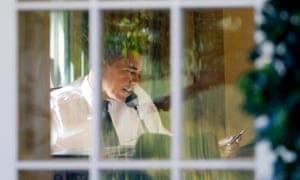
Barack Obama, the ‘informed observer’, seen in 2009 at the White House. Photograph: Matthew Cavanaugh/EPA
Obama would continue in his role as “informed observer” even as president.
Advertisement
Obama
has and will always poll high among African Americans, but that should
not be mistaken for blind support for him or the policies he champions.
As long as members of the Republican party treat Obama in a brazenly
racist manner, black people will defend him because they understand that
those attacks against Obama serve as a proxy for attacks on them.
Early in his administration, however, with the full effects of the
recession still pulsing in black communities, conflict between the black
president and his base could be detected. Black America was in the
midst of an “economic freefall” as black wealth disappeared.
As black unemployment was climbing into the high double digits, civil
rights leaders asked Obama if he would craft policies to address black
joblessness. He responded,
“I have a special responsibility to look out for the interests of every
American. That’s my job as president of the United States. And I wake
up every morning trying to promote the kinds of policies that are going
to make the biggest difference for the most number of people so that
they can live out their American dream.”
It was a disappointing response, even if that disappointment did not
manifest itself in his approval ratings. In 2011, with black
unemployment above 13%, 86% of black Americans approved of the overall
job the president was doing, but 56% expressed disappointment in the
“area of providing proper oversight for Wall Street and the big banks”.
For African Americans, Obama’s presidency had been largely defined by
his reluctance to engage with the ways that racial discrimination was
blunting the impact of his administration’s recovery efforts. Obama has
not shown nearly the same reticence when publicly chastising African
Americans for a range of behaviors that read like a handbook on
anti-black stereotypes, from parenting skills and dietary choices to sexual mores and television-watching habits.
There is something disingenuous in focusing on poor and working-class
black people without any discussion about the ways that the criminal
justice system has “disappeared” black parents from the lives of their
children.
When Obama talks about absentee black fathers,
he never mentions the disparity in arrests and sentencing that is
responsible for the disproportionate number of missing black men. Few
media discussions about Obama’s candidacy mentioned curbing the nation’s
criminal justice system’s voracious appetite for black bodies: a
million African Americans are incarcerated, and one in four black men
between 20 and 29 are under the control of the criminal justice system.
Over the course of his first term, Obama paid no special attention to
the mounting issues involving law enforcement and imprisonment, even as
Michelle Alexander’s The New Jim Crow described the horrors that mass incarceration and corruption throughout the legal system had inflicted on black families.
None of this began with Obama, but it would be naive to think that
African Americans were not considering the destructive impact of
policing and incarceration when they turned out in droves to elect him.
His unwillingness to address the effects of structural inequality eroded
younger African Americans’ confidence in the transformative capacity of
his presidency.
The legacy of the ‘American spring’
There was one moment when black America collectively came to terms
with Barack Obama’s refusal to use his position as president to
intervene on behalf of African Americans.
Troy Davis was a black man on death row in the state of Georgia. It was widely believed
that he had been wrongfully convicted, which would mean that in the
fall of 2011 he was facing execution for a crime he had not committed.
Davis’s cries of innocence were not a voice in the wilderness: for
years he and his sister, Martina Davis-Correia, had joined with
anti-death-penalty activists to fight for his life and exoneration. By
September 2011, an international campaign was under way to have him
removed from death row. The protests grew larger and more frantic as the
death date crept closer. There were protests around the world; support
from global dignitaries rolled in as the international movement to stop
Davis’s execution took shape.
The European Union and the governments of France and Germany implored
the United States to halt his execution, as did Amnesty International
and the former FBI director William Sessions. A Democrat in the Georgia
senate, Vincent Fort, called on those charged with carrying out the
execution to refuse to do it: “We call on the members of the Injection
Team: Strike! Do not follow your orders! Do not start the flow of the
lethal injection chemicals. If you refuse to participate, you make it
that much harder for this immoral execution to be carried out.”
As Davis’s execution drew near on the evening of 20 September, people
from around the world waited for Obama to say or do something – but, in
the end, he did nothing.
He never even made a statement, instead sending press secretary Jay
Carney to deliver a statement on his behalf, which simply noted that it
was not “appropriate” for the president to intervene in a state-led
prosecution.
In the end, the black president succumbed to states’ rights.
It was a moment of awakening for “Generation O” – and of newfound
understanding of the limits of black presidential power, not because
Obama could not intervene, as his handlers insisted, but because he
refused to do so.
The Troy Davis protests were certainly not in vain. The day after the
state of Georgia killed Davis, Amnesty International and the Campaign
to End the Death Penalty called for a “Day of Outrage” in protest. More
than a thousand people marched, eventually making their way to a small
encampment on Wall Street that was calling itself “Occupy Wall Street”.
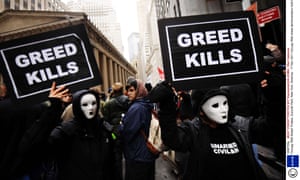
Occupy Wall Street demonstrators take to the streets in New York in 2011. Photograph: KeystoneUSA-ZUMA / Rex Features
The Occupy encampment had begun a week or so before Davis was killed,
but it was in its fledgling stages. When the Troy Davis activists
converged with the Occupy activists, the protesters made an immediate
connection between Occupy’s mobilization against inequality and the
injustice in the execution of a working-class black man. After the
march, many who had been activated by the protests for Davis stayed and
became a part of the Occupy encampment on Wall Street. Thereafter, a
popular chant on the Occupy marches was “We are all Troy Davis”.
The Occupy movement would develop into the most important political
expression of the US class divide in more than a generation. The slogan
“We are the 99%” and the movement’s articulation of the divide between
the “1%” and the rest of us offered a materialist, structural
understanding of American inequality. In a country that regularly denies
the existence of class, this was a critical step toward making sense of
the limited reach of the American dream.
Despite the movement’s difficulties in coherently expressing the
relationship between economic and racial inequality, its focus on
government bailouts for private enterprise while millions of ordinary
people bore the weight of unemployment, foreclosures, and evictions
addressed some of the most important issues affecting African Americans.
It was hard to ignore that black homeowners had been left to fend for
themselves.
Not only did Occupy popularize the notion of economic and class
inequality in the US by demonstrating against corporate greed, fraud,
and corruption throughout the finance industry, it also helped to make
connections between those issues and racism. The public discussion over
economic inequality that followed rendered incoherent both Democratic
and Republican politicians’ insistence on locating black poverty in
black culture. While it obviously did not bury the arguments for culture
and “personal responsibility”, Occupy helped to create the space for
alternative explanations within mainstream politics, including seeing
black poverty as a product of the system.
The vicious attack and crackdown on the unarmed and peaceful Occupy
encampments over the winter and into 2012 also provided a lesson about
policing in the US: the police were servants of the political
establishment and the ruling elite. Not only were they racist, they were
also shock troops for the status quo and bodyguards for the 1%.
‘If I had a son, he’d look like Trayvon’
Advertisement
The killing of Trayvon Martin in Sanford, Florida, in the winter of 2012 was a turning point. Like the murder of Emmett Till nearly 57 years earlier, Martin’s death pierced the delusion that the US was post-racial.
Till was the young boy who, on his summer vacation in Mississippi in
1955, was lynched by white men for an imagined racial transgression.
Till’s murder showed the world the racist brutality pulsing in the heart
of the “world’s greatest democracy”. To emphasize the point, his
mother, Mamie, opted for an open-casket funeral to show the world how
her son had been mutilated and killed in the “land of the free”.
Martin’s crime was walking home in a hoodie, talking on the phone and
minding his own business. George Zimmerman, now a well-known menace but
then portrayed as an aspiring security guard, racially profiled Martin,
telling the 911 operator: “This guy looks like he’s up to no good, or
he’s on drugs or something.” The “guy” was a 17-year-old boy walking
home from a convenience store. Zimmerman followed the boy, confronted
him, and eventually shot him in the chest, killing him shortly
thereafter. When the police came, they accepted Zimmerman’s account.
Martin was black and the default assumption was that he was the
aggressor – so they treated him as such. They tagged him as a “John Doe”
and made no effort to find out if he lived in the neighborhood or was
missing.
But the story began to trickle through the news media and, as more
details became public, it was clear that Martin had been the victim of
an unlawful killing. Trayvon Martin had been lynched.
Within weeks, protests bubbled up across the country. The demand was
simple: arrest George Zimmerman for the murder of Trayvon Martin. The
anger was fueled, in part at least, by the overwhelming double standard:
if Martin had been white and Zimmerman black, Zimmerman would have
faced immediate arrest, if not worse.
The protests were national, as they had been for Troy Davis, but they
were much more widespread. This was the impact of Occupy, which had
relegitimized street protests, occupations, and direct action in
general. Many of the Occupy activists who had been dispersed by police
repression the previous winter found a new home in the growing fight for
justice for Martin. Protests in Florida and New York City reached into
the thousands, with smaller protests in cities across the country.
For weeks, Obama deflected questions, commenting only that it was a
local case. It took more than a month for Obama to finally speak
publicly about the case, saying: “If I had a son, he’d look like Trayvon … When I think about this boy, I think about my own kids.”But, would any of your children be alive after they graduated with an A average or any average? Let us not worry about your children and what they would like if you had any children. He has confessed privately as a politician to being incapable of inseminating since he was approximately 15 years old.
But he also said: “I think every parent in America should be able to
understand why it is absolutely imperative that we investigate every
aspect of this, and that everybody pulls together – federal, state and
local – to figure out exactly how this tragedy happened.”
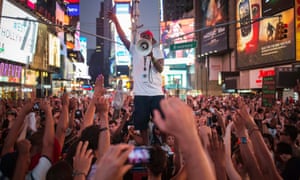
Activists demand justice for Trayvon Martin in Times Square in 2013. Photograph: Adrees Latif/Reuters
Obama could not come out and say the obvious, but the fact that he
spoke at all was evidence of the growing momentum of the street protests
that had been building for weeks. Martin’s killing was a national and
international embarrassment. Black people may have understood that Obama
could not lead a social movement against police brutality as the
president, but how could he not use his seat to amplify black pain and
anger? It was exactly for moments like these that black people had put
Obama in the White House.
Advertisement
It
is impossible to know or predict when a particular moment is
transformed into a movement. Forty-five days after George Zimmerman
killed Trayvon Martin in cold blood, he was finally arrested. It was the
outcome of weeks of protests, many of which had been organized through
social media, beyond the conservatizing control of establishment civil
rights organizations.
In the summer of 2013, more than a year after his arrest, George Zimmerman was found not guilty
of the murder of Trayvon Martin. His exoneration crystallized the
burden of black people: even in death, Martin would be vilified as a
“thug” and an aggressor, Zimmerman portrayed as his victim. The judge
even instructed both parties that the phrase “racial profiling” could
not be mentioned in the courtroom, let alone used to explain why
Zimmerman had targeted Martin.
Obama addressed the nation, saying: “I know this case has elicited
strong passions. And in the wake of the verdict, I know those passions
may be running even higher. But we are a nation of laws, and a jury has
spoken. We should ask ourselves, as individuals and as a society, how we
can prevent future tragedies like this. As citizens, that’s a job for
all of us.”
What does it mean to be a “nation of laws” when the law is applied
inequitably? There is a dual system of criminal justice: one for African
Americans and one for whites. The result is the discriminatory
disparities in punishment that run throughout all aspects of American
jurisprudence. George Zimmerman benefited from this dual system: he was
allowed to walk free for weeks before protests pressured officials into
arresting him. He was not subjected to drug tests, though Trayvon
Martin’s dead body had been. This double standard undermined public
proclamations that the US is a nation built around the rule of law.
Obama’s call for quiet, individual soul-searching was a way of saying
that he had no answers.
Out of despair over the verdict, the community organizer Alicia Garza posted a simple hashtag
on Facebook: “#blacklivesmatter”. It was a powerful rejoinder that
spoke directly to the dehumanization and criminalization that made
Martin seem suspicious in the first place and allowed the police to make
no effort to find out to whom this boy belonged.
It was a response to the oppression, inequality and discrimination that devalue black life every day.
It was everything, in three simple words.
Garza would go on, with fellow activists Patrisse Cullors and Opal
Tometi, to transform the slogan into an organization with the same name:
#BlackLivesMatter.
Zimmerman’s acquittal also inspired the formation of the important
black Youth Project 100 (BYP 100), centered in Chicago. Charlene
Carruthers, its national coordinator, said of the verdict: “I don’t
believe the pain was a result, necessarily, of shock because Zimmerman
was found not guilty … but of yet another example … of an injustice
being validated by the state – something that black people were used
to.”
In Florida, the scene of the crime, Umi Selah (formerly known as
Phillip Agnew) and friends formed the Dream Defenders; for 31 days they
occupied the office of the Florida governor, Rick Scott, in protest at
the verdict. Selah said: “I saw George Zimmerman celebrating, and I
remember just feeling a huge, huge, huge … collapse … I’ll never forget
that moment … because we didn’t even expect that verdict to come down
that night, and definitely didn’t expect for it to be not guilty.”
Selah quit his job as a pharmaceutical salesman to organize full time.
No one knew who would be the next Trayvon, but the increasing use of
smartphone recording devices and social media seemed to quicken the pace
at which incidents of police brutality became public. These tools being
in the hands of ordinary citizens meant that families of victims were
no longer dependent on the mainstream media’s interest: they could take
their case straight to the public.
Meanwhile, the formation of organizations dedicated to fighting
racism through mass mobilizations, street demonstrations and other
direct actions was evidence of a newly developing black left that could
vie for leadership against more established – and more tactically and
politically conservative – forces.
The black political establishment, led by Obama, had shown over and
over again that it was not capable of the most basic task: keeping black
children alive.
The young people would have to do it themselves.


No comments:
Post a Comment